
Regulation Is No Longer Separate from Product Development
For years, companies discussed MDR and IVDR as if they were approaching storms. Conferences, webinars and industry panels often revolved around the same question: are companies ready?
Today, the situation looks different.
The transition phase is no longer the main story. Instead, the real change lies in how these regulations influence the way medical devices are conceived, developed, manufactured, and maintained.
Perhaps the biggest shift is this: compliance can no longer stay at the end of the project. It now needs to enter the development process from the beginning.
Under the old framework, many companies could separate product development from regulatory strategy. Industrial design moved forward, engineering solved technical problems, prototypes came quickly, and documentation often arrived later.
Even the earliest development decisions now influence:
- clinical strategy
- usability validation
- manufacturing consistency
- supplier control
- and long-term market access
A material choice can affect biocompatibility.
A supplier decision can impact traceability.
A workflow detail can become a usability risk.
As a result, medical device development is becoming less compartmentalized and far more interconnected than before.
1. Clinical and Technical Evidence Must Start Earlier
One of the clearest consequences of MDR and IVDR is the need for stronger evidence earlier in the process.
In the past, companies often consolidated clinical reasoning and technical documentation after defining the product architecture. Today, regulators expect these foundations to emerge much earlier.
This changes the role of the concept phase itself.
A concept phase is no longer only about feasibility, usability, or aesthetics.
It also starts to define the future logic of the device, including:
- intended use,
- clinical rationale,
- user profile,
- risk assumptions,
- and benefit–risk balance
The earlier these elements become clear, the lower the risk of expensive redesign loops later in the process.
The earlier these elements become clear, the lower the risk of expensive redesign loops later in the process.
In practice, many regulatory problems begin with decisions made very early, when the product still appears simple.
2. Human Factors and Risk Management Have Become Central

Another major shift concerns usability and risk management.
For years, some companies treated human factors engineering as a validation activity near the end of development. Now, regulators increasingly expect usability to shape the design from the start.
This matters especially for:
- home-care devices,
- wearables,
- handheld systems,
- connected products,
- and technologies used by non-professional users.
As healthcare moves outside hospitals, complexity does not disappear. It simply moves into interfaces, workflows, instructions, and real-world interactions.
A device can be technically advanced and still fail if users misunderstand it, misuse it, or experience friction while operating it.
Therefore, design now has a wider responsibility.
Good design is not only about aesthetics or ergonomics. It also contributes directly to risk reduction.
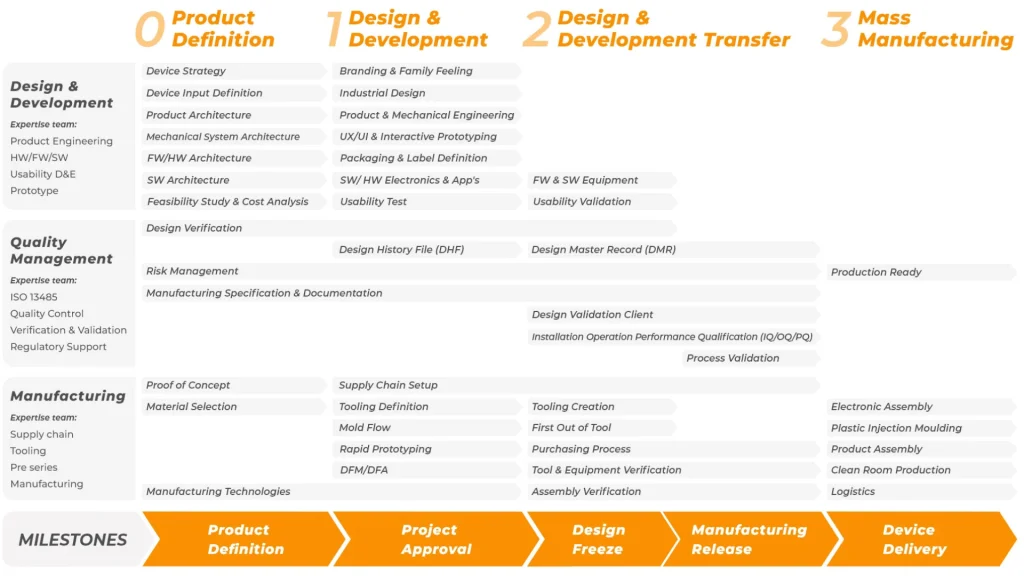
3. Documentation Must Be Coherent, Not Merely Complete
Under MDR and IVDR, one recurring challenge is not only missing documentation. More often, the problem is inconsistent documentation.
Regulators expect the entire development process to tell one coherent story.
For example, if the clinical evaluation supports a specific intended use, the risk file should reflect it. If usability testing identifies hazards, design controls should respond to them. If post-market surveillance reveals recurring issues, development teams should use that information to improve the product.
In other words, documentation no longer works as a collection of separate files prepared by different departments.
It works as an interconnected system.
This is where many organizations still struggle.
Not because teams lack competence, but because medical device development has often been fragmented:
- design in one place,
- engineering somewhere else,
- manufacturing outsourced,
- regulatory added later,
- and suppliers managed independently.
The more fragmented the process becomes, the harder it is to maintain consistency across the entire lifecycle of the device.
4. Post-Market Surveillance Is Becoming a Continuous Design Input
Under MDR and IVDR, products do not simply become “finished” once they reach the market.
Post-market surveillance is evolving from a periodic regulatory activity into a continuous feedback loop.
Real-world data, complaints, maintenance information, and user feedback increasingly influence:
- risk management,
- labeling,
- clinical evaluation,
- and future product improvements.
Consequently, development teams need to think differently about the product lifecycle.
Medical devices are becoming systems that require continuous observation and refinement over time.
For this reason, companies have a growing incentive to design products that are easier to
- monitor,
- trace,
- update,
- and manufacture consistently.
5. Manufacturing and Supplier Control Are Under Greater Scrutiny
MDR and IVDR also affect manufacturing and supplier management.
Auditors now examine several aspects more closely, including the following:
- traceability systems,
- supplier controls,
- cleanroom procedures,
- change-management processes,
- production consistency,
- and quality-system integration.
The expectation is no longer simply to manufacture the device correctly. Companies must also demonstrate continuous control over how that device evolves over time.
This has major implications for organizations that rely on fragmented development ecosystems. When industrial design, engineering, electronics, tooling, and manufacturing sit across disconnected suppliers, consistency becomes harder to maintain.
As a result, documentation, traceability, and change control can quickly become more complex.
For this reason, many manufacturers are reassessing the value of integrated development and manufacturing models under robust ISO 13485 quality systems.
The ability to move from concept to industrialization without losing information, rationale, or traceability is becoming a competitive advantage.
Europe Is Entering a More Mature MDR/IVDR phase

The initial transition period created uncertainty across the industry. Companies had to deal with:
- evolving guidance,
- limited notified-body capacity,
- changing interpretations,
- and certification bottlenecks.
Today, the environment is more mature, but not necessarily simpler.
Manufacturers now need to operate within the logic of MDR and IVDR rather than adapt to them temporarily.
At the same time, new pressures continue to emerge, such as:
- software complexity,
- cybersecurity expectations,
- AI-enabled functionalities,
- sustainability considerations,
- and increasing scrutiny on real-world performance data.
Therefore, regulatory readiness is becoming part of product competitiveness itself.
A device developed without a structured regulatory mindset from the beginning will likely face delays, redesigns and avoidable costs later in development.
Regulation Is Becoming Part of Product Quality

MDR and IVDR are not temporary disruptions. They are reshaping the expectations around what a credible medical device company looks like in Europe.
The companies most likely to succeed will not necessarily be those that produce the fastest prototypes or the lowest-cost devices.
Instead, stronger companies will build products where:
- design,
- engineering,
- manufacturing,
- usability,
- clinical reasoning,
- and regulatory strategy
operate as one coherent system.
In this sense, regulation is no longer separate from innovation.
It is becoming one of the structures that determines whether innovation can survive in the real world.