
Don’t gamble with your R&D budget.
Milestone 0 is where raw concepts are transformed into a de-risked, bankable, and technically sound product roadmap, establishing the strategic, technical, and economic foundation for the entire project.
The Challenge:
Most product failures originate from incomplete or poorly defined design inputs. Advancing into detailed design or CAD development without a robust product definition often leads to costly redesigns, technical compromises, and delays later in development.
Our Approach:
We apply a multidisciplinary approach, checking and formally approving the completeness of the defined overall system architecture, ensuring:
– architecture consistency and coherency across subsystems,
– fulfillment of the intended use and performance requirements,
– a feasible transition to subsequent development including the main fields of industrial design, engineering, and manufacturing.
Outcome:
This milestone delivers a validated and strategically aligned product definition, reducing development risk and creating a solid foundation for efficient and controlled product realization.
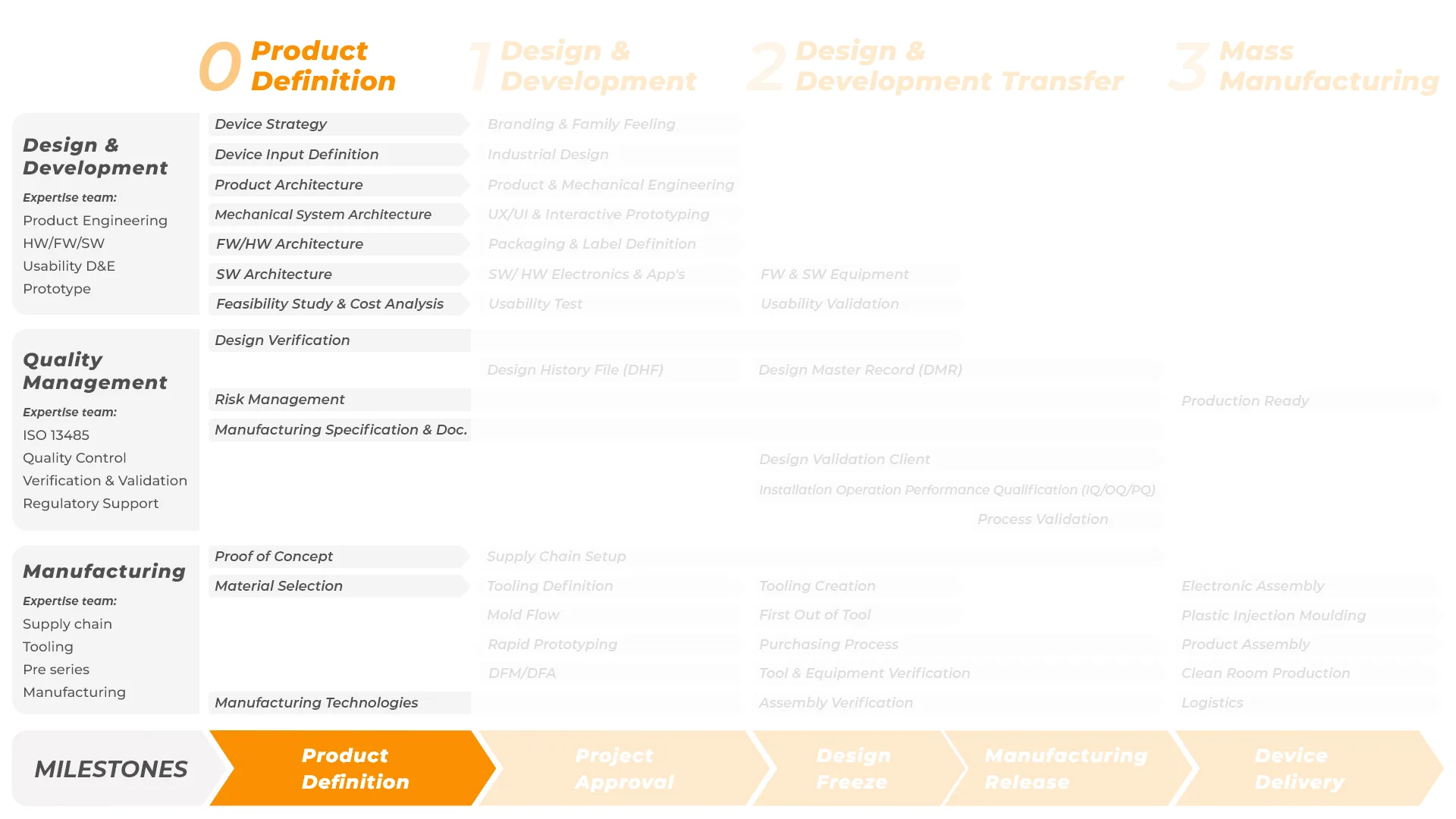
Expertise team:
Product Engineering
HW/FW/SW
Usability D&E
Prototype
Expertise team:
ISO 13485
Quality Control
Verification & Validation
Regulatory Support
Expertise team:
Supply chain
Tooling
Pre series
Manufacturing
Most products fail not due to lack of innovation, but because their technical, regulatory, and economic feasibility is not rigorously defined at the early stages. Advancing development based on assumptions often results in costly redesigns, manufacturing constraints, or regulatory delays that jeopardize timelines and investment.
Our integrated team spanning Design & Development, Quality Management, and Manufacturing performs a comprehensive feasibility and definition phase, establishing clear design inputs, manufacturing strategy, and cost framework ensuring your product is viable, compliant, and ready for efficient industrialization.
Defining the device’s intended use, target market positioning, competitive differentiation, long-term product strategy, all aligned with regulatory compliance
Translating user needs and stakeholder expectations into clear, traceable design input requirements that guide development
Laying out the mechanical architecture, structural design, and key constraints to ensure functionality, manufacturability, and reliability
Defining the structural design for firmware, hardware, and software systems to ensure compatibility and scalability
Defining the overall system architecture, including the interaction and integration of mechanical, electronic, and software components
Demonstrating and verifying the technical feasibility of the core concept to confirm the viability of the underlying technology
Establishing measurable verification criteria and test protocols to confirm that design outputs meet established design input requirements
Identifying potential technical, safety, or market risks early to develop mitigation strategies
Drafting the preliminary technical documents that will eventually guide the production process
A rigorous evaluation of whether the product can be built within the desired technical and financial constraints
Identifying the primary materials required to meet functional and regulatory standards
Determining which production methods (e.g., injection molding, 3D printing) are most suitable for the projected volumes
We guarantee that the devices we design and produce are safe, reliable, and compliant with global standards required by FDA and MDR, reducing non-compliance risks and accelerating regulatory approval.